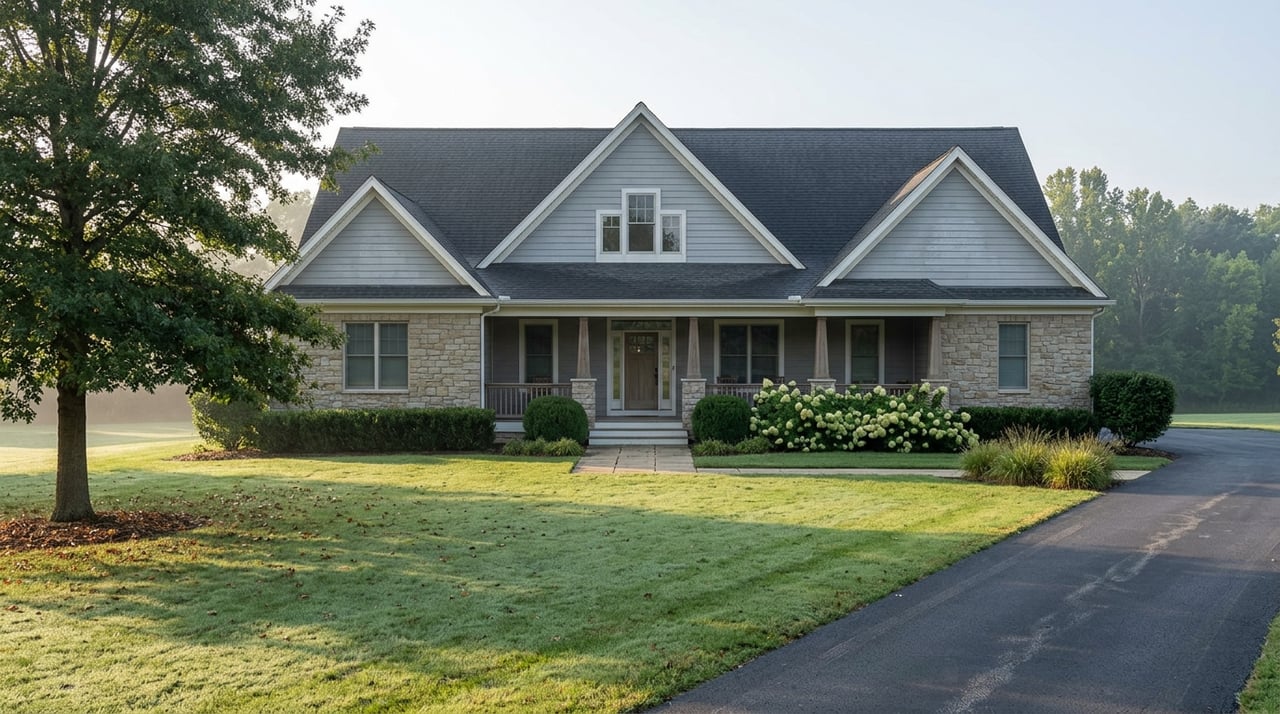
What the Price Gap Between King George and Waldorf Actually Buys You
September 3, 2026
September 3, 2026
Why would a buyer choose a smaller price tag across the river in King George, Virginia over a comparable Charles County, Maryland address just over the bridge in Waldorf? The easy answer is affordability. The real answer involves a toll that only charges you in one direction, a federal research lab that employs a striking share of the local workforce, and a bridge that got rebuilt for $462.9 million just a few years ago. None of that shows up on a listing sheet, and all of it changes what the lower price is actually compensating you for.
Start with the part most buyers never think to ask about until they're already driving it every day: the Governor Harry W. Nice Memorial and Senator Thomas "Mac" Middleton Bridge, the four-lane span carrying US 301 across the Potomac between Newburg, Maryland, and Dahlgren, Virginia. According to the Maryland Transportation Authority's current posted rates, the toll is collected in the southbound direction only, meaning you pay to cross into Maryland but not to cross back into Virginia. A two-axle vehicle pays $6 in cash or $4.50 with an E-ZPass Maryland account each time it heads south.
That directional quirk matters because it flips the usual assumption. A King George resident who works in Waldorf, La Plata, or anywhere else on the Maryland side pays the toll every workday morning and rides free every evening home. A Maryland resident who occasionally crosses the river for a weekend in Virginia pays nothing at all. The toll isn't a flat cost of living near the river. It's a cost that attaches specifically to the commute pattern of someone living in King George and working in Southern Maryland, which happens to describe a meaningful share of the people asking whether the lower home price on the Virginia side is worth it.
Run the math on a regular commuter with an E-ZPass account: five round trips a week means five southbound tolls, or $22.50 a week, which comes to roughly $1,170 a year. That's a real number to hold up against whatever the home price gap actually is for a specific pair of listings, not an abstraction.
| Commute pattern | Southbound trips per week | Annual toll cost (E-ZPass) |
|---|---|---|
| Daily MD commuter | 5 | ~$1,170 |
| Hybrid/remote (2 days) | 2 | ~$468 |
| Occasional weekend crossing into Maryland | 1 | ~$234 |
The bridge itself is newer than most buyers assume. The original span was a narrow, two-lane structure with no median barrier and a history of head-on collisions and wide-load closures. The replacement opened to traffic in October 2022, four 12-foot lanes wide with a center median, and crews began tearing down the old span the following March. If your mental picture of "crossing the river to Virginia" still involves a single-lane bottleneck and holiday backups, that picture is a few years out of date. The commute friction that used to be a real argument against King George has largely been engineered away. What's left is the toll, which is a fixed and predictable cost rather than a random one.
Cost-of-living comparisons put King George running about 10 percent below Waldorf overall, a gap that shows up in housing, utilities, and day-to-day expenses rather than any single line item. That's a real, usable number, but it invites a follow-up question that most comparison pages skip: cheaper because of what?
Home values within King George itself illustrate why that question matters. Zillow's county-wide figure puts the average King George County home value at $472,297 as of April 2026, up 2.4 percent over the prior year. Zillow's separate, narrower figure for the King George census-designated place itself, a smaller geography inside the county, puts the current average at $413,923. Those aren't contradictory so much as they're describing different footprints, but a buyer comparing "King George's median" to "Waldorf's median" without checking which boundary each number is drawn around is comparing two different maps and calling it one.
This is the part where a headline stat stops doing the work and a local read has to take over. A 10 percent cost gap sounds like a discount. Whether it's a discount worth taking depends entirely on what's generating it, and in King George's case, the answer traces back to one employer.
King George County's economy runs substantially on the Naval Surface Warfare Center Dahlgren Division, the federal research and testing installation that has anchored the area since the early twentieth century. Federal Reserve researchers examining exposure to federal workforce reductions found that civilian federal employment in King George County accounts for nearly 24 percent of the county's civilian workforce, the second-highest concentration among the 20 US counties their analysis covered. That's not a criticism of Dahlgren or of King George. It's a structural fact about how concentrated the local job base is around one institution and one funding source: federal appropriations.
Compare that to the economic engine on the Maryland side. Waldorf and La Plata sit inside a commuter economy oriented toward the greater DC job market, which spreads employment risk across federal agencies, private contractors, healthcare systems, and everything else that pulls workers north up US 301 or Route 5 toward the Beltway. Neither structure is inherently safer. A single-employer economy can be remarkably stable for decades and then absorb a shock all at once if that employer's funding tightens. A diversified commuter economy is less exposed to any one decision in Washington but carries its own baseline cost, in commute time and in home prices, for that diversification.
What this means in practice: a buyer relocating specifically to work at Dahlgren is buying into a well-understood, long-standing local economy and picking up a real discount for doing it. A buyer choosing King George purely because the same house costs less than it does in Waldorf, without any tie to Dahlgren or a flexible remote arrangement, is taking on the county's employment concentration as a passenger rather than a beneficiary. That's a very different position to be in if federal budget priorities shift.
None of this argues for one town over the other. It argues for matching the trade-off to the buyer.
If you or a household member works at NSWC Dahlgren, or you're a remote worker whose paycheck doesn't depend on either county's local economy, King George's price advantage is close to a clean win. You're not exposed to the concentration risk in the same way, and the rebuilt bridge means the commute friction that used to make Southern Maryland buyers hesitate is largely gone.
If your job is in Maryland, particularly anywhere north toward the Beltway, run the actual toll cost against the actual price difference for the specific homes you're comparing, not the county averages. A $1,170 annual toll bill is real money, but it's also a small fraction of what a modest price gap between two comparable listings can represent over a typical ownership period. The math usually still favors King George for a Maryland-bound commuter, but it favors it by less than the sticker price alone suggests, and it's worth knowing the number rather than assuming it away.
If you're relocating for military service, government contracting, or corporate transfer and your employer's funding isn't tied to either county specifically, this is less about picking a side and more about being honest with yourself about how much commute time and toll cost you're willing to absorb for the lower price, and how comfortable you are with a smaller, more concentrated local job market if your plans change.
Does the Nice/Middleton Bridge toll apply if I only cross occasionally?
Yes, but only when you're heading south into Maryland. Northbound trips into Virginia aren't tolled at all; occasional southbound weekend crossings into Maryland are tolled, but still cost far less than a daily commute.
Is King George actually cheaper than Waldorf across every price band?
The county-wide comparison shows a real gap, but home values vary meaningfully depending on whether you're looking at the broader county or the King George census-designated place itself. Ask for comps on the specific neighborhood and price range you're considering rather than relying on a single county-wide average.
Is the federal employment concentration in King George a reason to avoid buying there?
Not necessarily. It's a factor to weigh against your own employment situation. A buyer whose income is tied to Dahlgren or to remote work outside the local economy carries less of that risk than a buyer whose plans assume the local job market will diversify.
Every one of these questions comes down to the same thing: the number on the listing page is a starting point, not the whole answer. If you're weighing a move across the Potomac and want the actual math run on specific properties rather than county averages, Theresa Shoptaw works both sides of Southern Maryland's relocation traffic and can walk you through what a given price gap really reflects. Let's Connect.
This article is general information, not legal, tax or financial advice. Consult a qualified professional about your situation.
Stay up to date on the latest real estate trends.




Thanks to her multi-faceted expertise, Theresa can offer her clients a comprehensive service. She is a true expert on the dynamics of the real estate market in the DMV, and she has a unique talent for educating her clients so that they can make informed decisions about their real estate investments. With her mastery of cutting-edge internet technologies, she can also market and find homes with exceptional speed and accuracy.