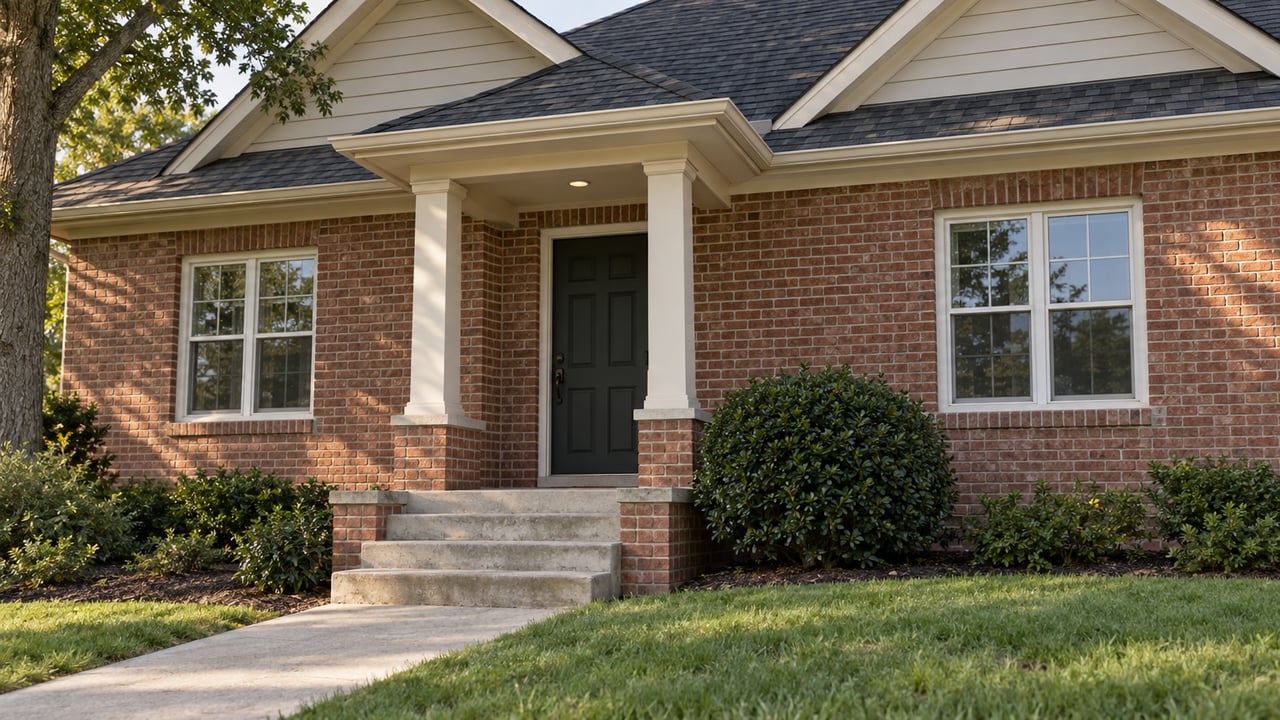
The County Line Decides Your Brandywine Tax Bill, Not the Rate on the Sheet
October 1, 2026
October 1, 2026
Two buyers put offers on Brandywine homes the same week this fall. Same price range, same square footage, same general commute to the Beltway. One of them will pay a noticeably different property tax bill than the other, and neither the listing sheet nor the ZIP code will tell them why. The answer sits on a line most people never think to ask about: Brandywine is not one taxing jurisdiction. It's two, and the two don't behave the way you'd expect.
Brandywine sits at the seam between Prince George's County and Charles County. That's not a rounding error in a database. It shows up in county tax records as two separate profiles for the same place name, and the ZIP code shared by both sides, 20613, appears identically on the Prince George's assessment data and the Charles County assessment data. A buyer scanning listings by ZIP has no way to tell which county's tax office will be sending the bill. The only way to know is to check the parcel itself.
That distinction matters more here than in most Southern Maryland communities, because the two counties don't just charge different rates. They charge for different things.
Prince George's County layers several charges into what shows up as one number on a tax bill. Public filings for fiscal year 2026 break the county's special property tax rate into four pieces: a general tax of $1.000 per $100 of assessed value, a Maryland-National Capital Park and Planning Commission levy of $0.294, a Washington Suburban Transit Commission charge of $0.026, and a stormwater fee of $0.054. Add those together and Prince George's County is charging roughly $1.374 per $100 of assessed value before anything else is factored in. Recent assessment data for the Brandywine, Prince George's County side puts the effective property tax rate at 1.40%, with a median annual bill of $5,047.
Charles County's side of Brandywine runs a simpler structure. There's no M-NCPPC parks levy, no transit commission charge, no stormwater assessment stacked on top of the base rate. The effective property tax rate on the Charles County side comes in lower, at 1.20%.
If the story stopped there, the math would be easy: Charles County side, lower rate, lower bill. It doesn't stop there.
The median annual tax bill on the Charles County side of Brandywine is $5,124. That's higher than the Prince George's County side's median bill of $5,047, despite Charles County's lower headline rate.
A rate only tells you the multiplier. It says nothing about the number it's being multiplied against, and that's where this flips. Maryland's Homestead Tax Credit caps how fast a home's taxable assessment can rise, limiting increases to 10% a year regardless of how much the market value has climbed. A home that's been assessed and reassessed over many years of ownership can carry a taxable value well below what it would fetch on the open market today. A home that's newer, or that changed hands more recently and had its assessment reset closer to current value, doesn't get that same cushion.
If Prince George's County's side of Brandywine has more homes that have been assessed under that cap for years, the higher rate is landing on an artificially suppressed number. If the Charles County side has a larger share of newer construction or recently reassessed properties, whose taxable value tracks closer to market price, the lower rate is landing on a bigger base. Multiply a small rate by a large number and you can still land ahead of a bigger rate on a small number. That appears to be exactly what's happening here.
For a buyer, the practical result is this: you cannot estimate what you'll owe by memorizing which county has the "better" rate. You have to look at the specific parcel.
The listing sheet won't carry this information, and the address alone won't settle it either, since the county line runs through neighborhoods that share the same ZIP. Before comparing two Brandywine properties on price alone, pull the actual tax record for each parcel. That record will show which county issued the assessment, what the current taxable value is, and what the most recent annual bill actually came to. Ask the listing agent for it directly if it isn't already in the disclosure package. A five-minute records check replaces a guess with a number, and on a purchase this size, a few hundred dollars a year in carrying cost is worth confirming rather than assuming.
| Side of the line | Effective tax rate | Median annual bill | What's layered into the rate |
|---|---|---|---|
| Prince George's County | 1.40% | $5,047 | General tax, M-NCPPC parks levy, WSTC transit charge, stormwater fee |
| Charles County | 1.20% | $5,124 | Base county levy, local school district and special taxing district charges |
Tax structure is one layer of what a Brandywine purchase actually costs. Price trend is the other, and right now the two sides of that trend are telling slightly different stories depending on which number you look at.
Homes that closed in Brandywine over the three months ending May 2026 sold for a median of $476,000, up 0.7% from the same period a year earlier. Those homes sold in about 38 days on average, with roughly two competing offers per listing, a pace that still counts as competitive. But the volume behind those sales dropped hard: 84 homes sold in May 2026, down from 154 in the same month the year before. Fewer transactions closing at prices holding roughly flat is a specific signal. It suggests the buyers still showing up are willing to pay close to last year's numbers for the right house, while a chunk of would-be sellers or buyers have stepped to the sidelines.
Listing prices tell a different part of the story. Homes listed for sale in Brandywine in September 2026 carried a median asking price of $486,000, down roughly 7% from September 2025. That's a meaningful gap between what sellers are asking and what buyers are actually paying to close, and it points to sellers resetting expectations faster than the market is forcing them to. For a buyer, that gap is where negotiating room tends to live: a listing priced against last year's expectations, sitting a little longer, is a different conversation than a fresh listing priced to this year's sold comps.
Layer that pricing picture on top of the tax question and the homework changes. A home on the Charles County side priced a little lower to match softening list prices might still carry the higher typical tax bill for that side of the line. A home on the Prince George's County side might carry the extra parks and transit levies but land on a lower total bill once the assessed value is accounted for. Price and tax burden don't move together here, and treating them as a single number hides both.
Does the county line affect anything besides the tax bill? Yes. Which county a Brandywine parcel sits in determines which county office handles permits, which public services respond to that address, and which school district the property is assigned to. None of that shows up on a listing photo, so it's worth confirming alongside the tax record rather than assuming based on the neighborhood name.
How do I find out which county a specific Brandywine address falls under? The parcel's tax record will name the county outright. Since the shared ZIP code doesn't distinguish the two sides, the fastest path is asking your agent to pull the assessment record for that exact address before you write an offer, not after.
If you're weighing a Brandywine purchase and want the tax and pricing picture pulled for a specific address before you write an offer, that's exactly the kind of homework Theresa Shoptaw does for buyers working this stretch of the county line. Let's Connect.
Stay up to date on the latest real estate trends.
Thanks to her multi-faceted expertise, Theresa can offer her clients a comprehensive service. She is a true expert on the dynamics of the real estate market in the DMV, and she has a unique talent for educating her clients so that they can make informed decisions about their real estate investments. With her mastery of cutting-edge internet technologies, she can also market and find homes with exceptional speed and accuracy.